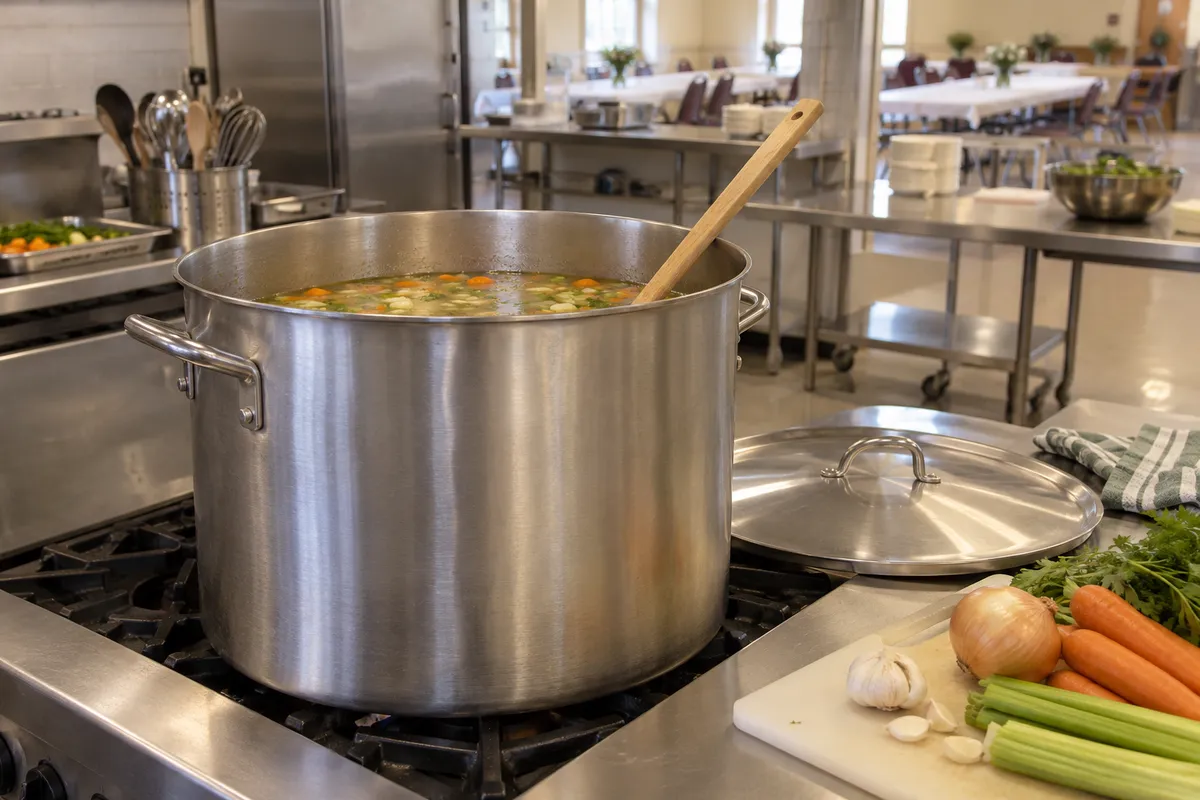
Do You Need a 100-Quart Stockpot? Cooking for a Crowd
As an Amazon Associate, I earn from qualifying purchases. This post may contain affiliate links.
Short answer: Most households do not need a 100-quart stockpot. But if you regularly feed a church group, reunion, fundraiser, farm crew, or large event, it can replace multiple competing pots—provided you already have a safe cooking, serving, cleaning, and storage plan.
There is a point where “just make a bigger batch” stops being simple. The recipe is no longer the hard part. The hard part is realizing your largest pot will not hold enough, your stovetop may not support the weight, and nobody has discussed how the finished food is getting from the cooking area to the serving table.
That is when a 100-quart stockpot starts looking less excessive and more like an actual solution.
The reality check: A 100-quart pot holds up to 25 gallons. Water alone would weigh roughly 208 pounds at full stated capacity—before counting the pot or the food. This is serious equipment for serious volume.
I have not personally tested this stockpot yet. This guide is here to help you decide whether a pot this large fits the way you actually cook—and what you need to solve before ordering one.
The 100-Quart Stockpot That Caught My Attention
The current listing describes a 100-quart stainless-steel stockpot with a lid and heavy-duty tri-ply bottom. It is marketed for boiling and cooking large quantities of soup and stew.
That makes it potentially useful for churches, community events, reunions, fundraisers, holiday gatherings, seafood boils, farm or harvest days, and other situations where several ordinary pots create more work.
Check the current price and availability on Amazon
The capacity is the selling point—but it is also the reason to slow down and plan before buying.
Who Actually Needs a 100-Quart Stockpot?
A pot this large may make sense if you regularly cook for:
Church suppers or ministry events
Community fundraisers
Family reunions and graduation parties
Large holiday gatherings
Farm crews, harvest days, or volunteer groups
Seafood boils or outdoor cooking events
Clubs, teams, camps, or group retreats
A small catering, food-service, or event operation
If your biggest gathering happens once every few years, borrowing or renting may make more sense. If you repeatedly borrow three pots, split one recipe into several batches, and struggle to keep everything at the same temperature, owning the right equipment may remove a real bottleneck.
The First Question Is Not “How Many People?”
The first question is: where and how will you safely use it?
A pot this large needs more than a recipe. It needs a stable cooking setup rated for the weight and compatible with the pot. Do not assume an ordinary household stovetop, glass cooktop, folding table, portable burner, or outdoor stand can support it.
Confirm these details before ordering
The stockpot’s exact dimensions
The manufacturer’s recommended heat sources
The weight limit of the cooking surface or stand
Filling and handling instructions
Clearance around the pot and lid
Ventilation requirements
A safe way to add ingredients and stir
A plan for serving the food without lifting a full pot
The right pot on the wrong setup is not a solution.
The Weight Changes Everything
This is not the pot to fill in the sink and then carry to the burner.
A workable plan may involve positioning the empty pot first, adding liquid where it will be heated, cooking well below the rim, and portioning the food out before moving the pot. Follow the manufacturer’s directions and the safety rules for your equipment.
Also decide who will be available to help. A commercial-size pot is not something one person should be expected to wrestle with after everyone else has moved to the serving area.
Real hospitality should not require someone to get hurt behind the scenes.
How Much Food Does 100 Quarts Make?
The mathematical capacity is 25 gallons, but that does not mean you should cook 25 gallons of food. Recipes need headroom for stirring, simmering, expansion, and safe handling. Broth-based soup, thick chili, pasta, and a seafood boil will not create the same number of servings from the same pot.
Work backward from a recipe you already know:
Choose the actual serving size.
Confirm how many finished servings one tested batch produces.
Scale only after determining that the recipe can be multiplied safely.
Leave enough room to stir without spilling.
Plan for seconds without overfilling the equipment.
For a first event, a smaller trial run is wiser than discovering during service that the scaled recipe cooks differently.
What the Tri-Ply Bottom Means
The listing describes a heavy-duty tri-ply bottom. A layered base is generally designed to distribute heat more evenly than thin single-layer metal, which can help when a large volume of food is sitting over a concentrated heat source.
That does not make the pot scorch-proof. Thick soups, beans, dairy-based recipes, and sauces still need the correct heat and consistent stirring. The bottom construction is helpful; it does not replace good cooking practices.
Where a Pot This Size Makes Sense
Large-batch soup or chili
This is the clearest fit. One coordinated batch may be easier to season consistently than several separate pots, provided the recipe scales well and you have a safe stirring method.
Church and community meals
When the meal is part of serving people, the kitchen needs to function. A large stockpot may reduce the number of burners, lids, pots, and separate batches required—without exhausting the volunteers.
Seafood boils and outdoor events
Verify the heat source, basket needs, outdoor-use instructions, and included accessories before planning the event. Do not assume every item shown in listing photos comes with the pot.
Farm, harvest, or work-crew meals
If you regularly feed a large group on the property, commercial-size cookware may be more practical than turning an everyday kitchen into a temporary cafeteria.
Large family events
Reunions, graduations, and holidays can justify large equipment when your family gathers in genuinely large numbers—not simply because an online video made the pot look useful.
What I Would Not Assume
I would not automatically use it as a water-bath canner. A large pot is not automatically appropriate canning equipment. Safe water-bath canning requires the correct depth, rack, tested recipe, processing time, altitude adjustment, and a heat source capable of supporting the full load.
I would not assume it works on every burner.
I would not assume the handles are designed for carrying it while full.
I would not assume stainless steel means nothing can stick or scorch.
I would not buy it before measuring the doorway, cooking area, sink, cleaning area, and storage location.
Cleanup and Storage Are Part of the Purchase
A 100-quart stockpot has to be washed and stored somewhere. Before buying, ask:
Will it fit in the sink or cleaning area?
Can it be washed without damaging nearby counters?
Where will it drain and dry?
Where will the oversized lid live?
Can it be stored covered or upside down?
Will storing it block something used every week?
Large cookware is valuable only when the entire routine works—from storage and setup through serving and cleanup.
One small thing that helps with any big pot: a ladle and lid rest next to the stove. It gives the dripping ladle and hot lid somewhere to go, so the counter does not turn into part of the cleanup.
When Several Smaller Pots Are Better
One enormous pot is not always more efficient. Several smaller pots may work better when:
You need vegetarian, allergy-friendly, or different spice-level options
Your cooking equipment cannot support one heavy load
Multiple people are cooking in separate locations
The finished food must be transported
You cannot safely stir or serve from a very tall pot
You rarely cook for a group this size
The best system is the one your actual helpers can use safely—not the setup that looks most impressive in a photograph.
For most weeknights, a regular-size pot does the job. An enameled cast iron Dutch oven handles soup, chili or a roast for the family, goes from stovetop to oven, and fits in a normal cabinet. Save the big pot for the big days.
Real-Life Before-You-Buy Checklist
We cook for large groups more than occasionally.
We have a compatible, weight-rated cooking setup.
We know exactly where the pot will be used.
We have a safe filling, stirring, serving, and cooling plan.
We can clean and store it.
We will have help available during the event.
We know which accessories are—and are not—included.
We have reviewed the current listing and manufacturer’s instructions.
If several answers are “not yet,” solve the setup before ordering the pot.
The Bottom Line
Buy it if: you repeatedly cook for genuinely large groups, have compatible equipment, and several smaller pots are creating a real bottleneck.
Skip it if: the event is occasional, you would need to improvise the heat source, or you do not already know how you will fill, stir, serve, clean, and store it.
A 100-quart stockpot can be an excellent tool for the right household, church, event team, or community group. But bigger is not automatically better. Its value comes from having the right space, enough help, and a plan that protects the people doing the work.
Hospitality is not about proving how much one person can carry. It is about making room at the table and sharing the work with wisdom.
See the 100-quart stockpot and current details on Amazon
Want a few good deals a day? I share Walmart and Amazon finds families actually use in my free Facebook group.
Join Real Life with Alyssa: Deals & Finds →